
With Talks Stalled and Time Running Out, What Are Modi’s Next Moves?
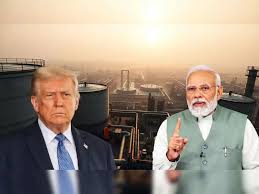
India stands on the edge of a major trade disruption as US President Donald Trump’s administration threatens to impose a crippling 50 per cent tariff on Indian imports. If no breakthrough is achieved within three weeks, the consequences for India’s economy could be historic.
With over $87 billion in annual exports to the US on the line — representing approximately 2% of India’s GDP — New Delhi must now navigate a high-stakes economic standoff. Here’s how India could respond to avoid long-term damage and protect its economic sovereignty.
Option 1: Negotiate — But at What Cost?
Farm, Dairy, and Oil Hurdles Stall Deal with Trump’s Trade Team
India was once poised to be among the first nations to ink a trade deal under Trump’s second administration. But after five failed negotiation rounds, talks broke down — primarily due to US demands that India open up its sensitive agriculture and dairy sectors, and cut oil imports from Russia.
While Indian officials have expressed frustration with the proposed tariffs, they’re leaving the door open. A US trade delegation is expected in New Delhi later this month, and both sides are hoping for a thaw.
Prime Minister Narendra Modi, while not directly naming the US, made his stance clear: “I am ready to pay a heavy price, but will not compromise on the well-being of our farmers, dairy sector, and fishermen.”
Yet behind closed doors, Indian officials are reportedly willing to consider limited tariff cuts on select US farm goods, such as almonds and cheese, to find middle ground.
Option 2: Reduce Dependence on Russian Oil
Can India Wean Off Russia Without Paying a Premium?
India’s energy dependence is another hot button. Once a minor customer, India now imports over one-third of its crude oil from Russia, driven by steep wartime discounts.
However, mounting pressure from the US and diminishing price advantages have led to Indian oil giants — Indian Oil, Hindustan Petroleum, Bharat Petroleum, and Mangalore Refinery — scaling back purchases.
India sources oil from over 40 countries, including the UAE, Saudi Arabia, Iraq, and the US. Yet removing Russian barrels from the mix could result in global price spikes, Indian energy officials warn.
Still, India is ready to diversify further — though at what cost remains to be seen.
Option 3: Form a United Front with Developing Nations
BRICS, African Union May Be Key to Countering US Pressure
India isn’t alone in facing the trade hammer. Brazil, another target of Trump’s tariff hike, is now coordinating with India under the BRICS bloc, which includes Russia, China, and South Africa.
Brazilian President Luiz Inácio Lula da Silva, who currently leads BRICS, said he plans to call Modi, China’s Xi Jinping, and other global leaders to form a coordinated response.
A senior Indian official emphasized the need to repair US ties while strengthening coalitions with countries also hit by US protectionism, including the African Union.
Rebuilding Bridges with Russia and China
India’s National Security Advisor is already in Moscow, and Foreign Minister S. Jaishankar is due shortly, paving the way for a potential visit by President Putin later this year. Russia described the discussions as centered on strengthening their “privileged strategic partnership.”
Simultaneously, India is reviving dialogue with China after years of border tensions. Modi is set to attend a regional security summit in China, his first visit since 2018, alongside Putin and Xi — signaling a potential geopolitical pivot.
What’s at Stake if India Fails to Strike a Deal?
A Devastating Blow to Trade, Visas, and Outsourcing
India’s exports to the US span high-value sectors: pharmaceuticals, garments, gems and jewellery, and petrochemicals. If the 50% tariff becomes reality, the vast majority of these could become uncompetitive overnight.
Pharmaceutical exports — often exempt from standard duties — may be India’s only surviving trade link to the US.
But the fallout may extend beyond goods. Analysts warn of a spillover into tech visas and offshoring. The US may impose tighter controls on H-1B visas and service outsourcing, both lifelines for India’s booming IT and business process outsourcing (BPO) sectors.
“This isn’t just about trade anymore — it’s about the future of India’s tech and services industry,” said an industry consultant familiar with US-India policy.
Can India Walk the Tightrope?
With economic nationalism on the rise in the US and India unwilling to compromise on domestic priorities, the room for maneuver is shrinking fast. Modi’s government faces a difficult choice: yield strategically or weather the economic storm.
India’s next steps — and how Trump responds — could define the trajectory of the world’s fastest-growing major economy.
Stay tuned. The next three weeks could reshape the future of US-India trade.